5 minPublished: Nov 25, 2026
ArticleLife Sciences

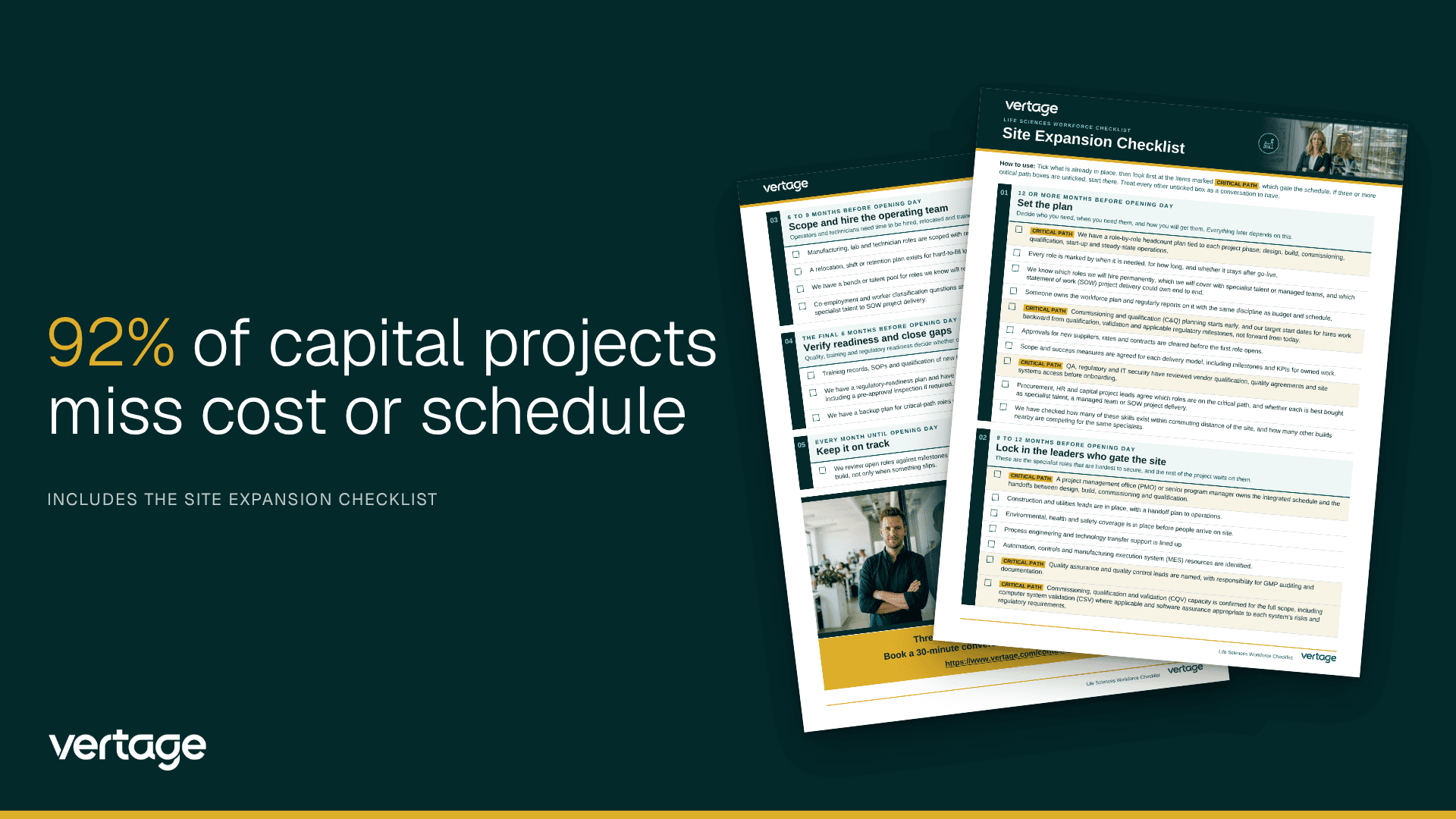
92% of Capital Projects Miss Cost or Schedule

As part of our "60 Second Stat Series", here's a quick read about important workforce planning statistics (and a checklist to keep you on track.)

V

Vertage

92%¹ of capital projects across industries miss cost or schedule.

That is an enormous percentage. An intimidating one, especially for site expansions, where every week of delay pushes out revenue and ties up capital.
One big factor in delays is late workforce planning. Staffing is on a site expansion's critical path, so a late hire can decide the deadline.


The 12-month fix

  • A full year before opening day, start counting heads. Build a role-by-role headcount plan tied to each phase: design, build, commissioning, qualification, start-up and steady-state.
  • Mark each role by when it's needed, how long, and whether it stays after go-live.
  • Assign an owner. Right now. Name one person to own the workforce plan, as you would for budget or schedule, and have them report regularly.

Work backward

  • Set hire dates from qualification and inspection dates, not from today.
  • Clear supplier, rate and contract approvals before the first role opens, and decide whether suppliers are measured by hours or milestones.

Lock in the "gating roles" 9 to 12 months before opening day

  • Leadership: a program management office (PMO) or senior program manager to own the integrated schedule and the handoffs between design, build, commissioning, and qualification.
  • Build and systems: construction, utilities, environment, health and safety (EHS), process engineering, automation and manufacturing execution systems (MES).
  • Quality: QA and QC leads, including good manufacturing practice (GMP) auditing and documentation. Bring Quality and IT security into the plan early, before system access and sign-offs are needed.
  • Validation: confirm commissioning, qualification and validation (CQV) and computer system validation (CSV) capacity for the full scope, not just the first system.
  • Market and backup: check local talent supply and nearby builds competing for the same specialists and name the three roles that would stop the project if still unfilled.

Match the model to each role

  • Specialist talent for individual roles, managed teams for a whole function, statement of work (SOW) project delivery for a full workstream like CQV, validation or PMO.
  • Decide now to avoid renegotiating mid-build and review co-employment and worker classification whenever the model changes.
  • Keep the same workforce partner as the model changes.

Download your Site Expansion Checklist

Loading form…

¹ Accenture, "Blueprint for Success" (February 2025), survey of 700 infrastructure and capital projects leaders across industries. ² Kneat, 2026 State of Validation (April 2026), survey of 614 validation professionals.